
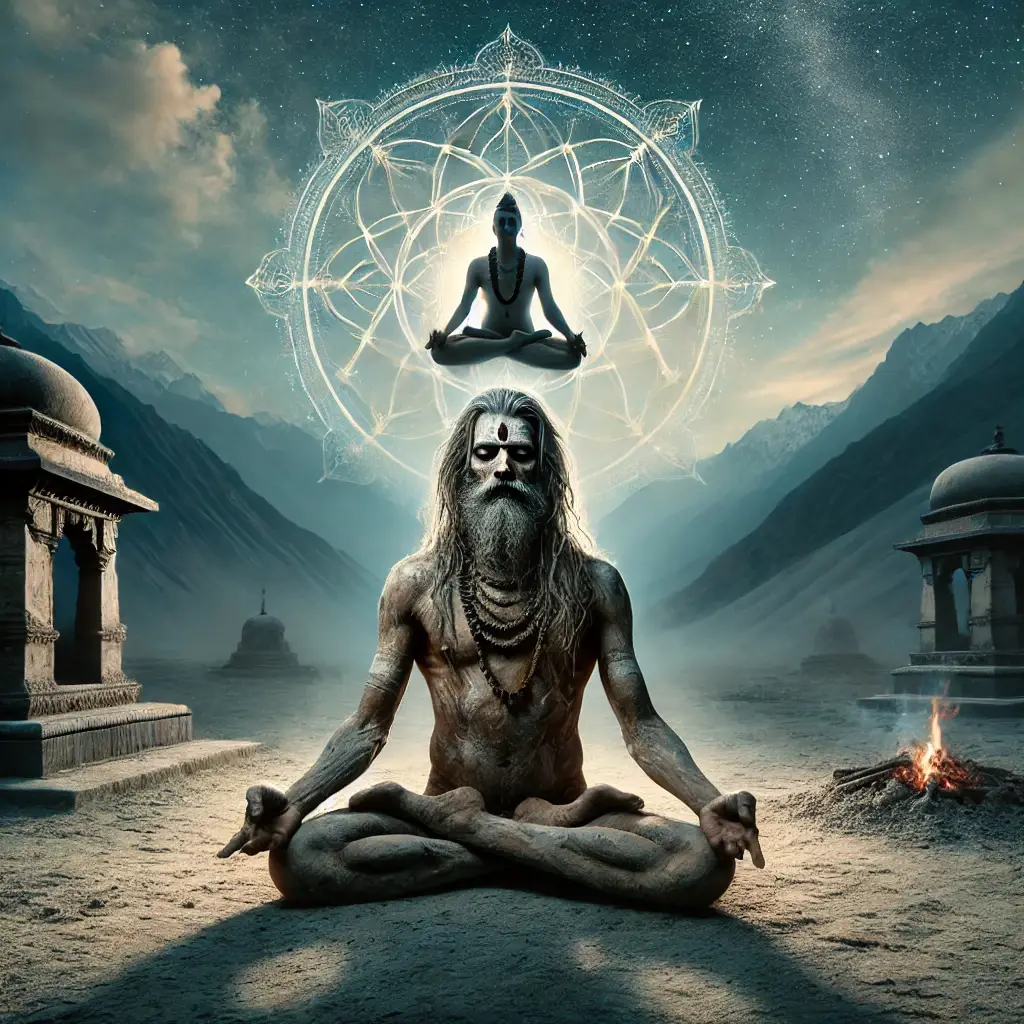
At Vyoma Bindu Akhada, we hold the highest reverence for Adi Sankara Bhagavatpadacharya, not merely as a jnani or acharya, but as the embodiment of Sanatana Dharma’s deepest spiritual logic. His parampara continues to guide seekers across centuries, especially through the luminous Jyotirmath, Sringeri, and Puri Peethams. We bow to the paramapujya Shree Jagadgurus of these institutions, recognizing their role as dharmarakshakas. However, we also note, with pain, that the Dwaraka Peetham today appears to have compromised its original intent by aligning itself with secular agendas disconnected from the dharmic core.
For those of us who walk the path of Aghora—especially as transmitted through the Vyoma Bindu parampara, later formally integrated into the Natha Sampradaya by Madhusudhanananda Saraswati—the teachings of Adi Sankara Bhagavatpadacharya are not foreign. They are foundational. Yet, time and again, there emerges an argument that Bhagavatpadacharya entirely rejected Rajasika and Tamasika sadhanas, choosing only Sattvika ones as valid. This simplistic conclusion neither reflects his granthas nor aligns with the lived sadhana of many lineages he silently supported through his deeper writings.
Contextualizing the Critique of Rajasika-Tamasika Practices
In his revered commentary on the Bhagavad Gita (3.26), Adi Sankara Bhagavatpadacharya writes:
na buddhibhedaṁ janayed ajñānāṁ karmasaṅginām
A clear instruction: the wise should not disturb the minds of those attached to karma. He critiques not the external practice but its attachment without inner viveka. Similarly, in Gita 17.6, he warns against self-destructive rituals:
karṣayantaḥ śarīrasthaṁ bhūtagrāmam acetasaḥ… tān viddhy āsuran niścayān
Here again, the rejection is not of the Tamasika ritual itself but of the ahankara and aviveka in its execution.
In essence, Bhagavatpadacharya speaks against the pravritti devoid of adhikāra, not against the tattva underlying the ritual paths.
The Aghora Interpretation: Transmutation, Not Indulgence
In the Vyoma Bindu parampara, the Pancha Makaras are never treated literally or indulgently. We explicitly reject mamsa bali and matsya bali, viewing them as incompatible with the spirit of ahimsa and dharmic restraint, especially in Kali Yuga. We encourage Maithuna only with one’s Dharmapatni, within the grihastha āśrama, recognizing its role in deep rasānubhava, not as a tool for adharmic libertinism. Madya, too, is used symbolically—as Soma, as rasa—evoking the nectar of the Devi within, not alcohol for the senses.
This aligns with the core Aghora idea of Sarvābhāvastha, where Bhairava pervades all states. In the hands of an adhikāri, what appears Tamasika becomes Sattvika through intent, discipline, and surrender.
Granthic Grounding: The Bhāgavata and the Gita Support Gradual Transformation
Śrīmad Bhāgavatam (11.21.2) states:
karmaṇām parināmena jñānam utpadyate nṛṇām | kriyā-yogaḥ śanair bhaktiṁ jñānaṁ ca janayet tataḥ ||
Through karma, jñāna arises. Even intense or seemingly lower practices can, with the right bhāva, lead to bhakti and jñāna. This reflects what many sampradayas, including ours, hold—adhikāra determines the upāya.
Even in the Gita, when Krishna describes the three gunas of yajna, food, and tapa, he does not say “only Sattva is valid.” He says, “Sattva liberates, Rajas binds, Tamas deludes”—but he never denies that all three exist as pathways for various adhikāris.
Shankara’s Own Compositions Are Replete with Tantric Imagery
Let us not ignore what is in plain sight.
Soundarya Lahari (24):
katākṣavyākṣepabhramaramukha-tambūla-rasikāḥ…
This stotra praises the Devi’s attendants, intoxicated by Her sidelong glance, chewing tambūla. The imagery is unabashedly Rajasika—and yet, it is revered by all. Why? Because it elevates.
Ananda Lahari (10):
Sudhāsindhor madhye suraviṭapi vāṭī…
The verse speaks of the Devi and Paramaśiva united in the bindu within maṇidvīpa—a clear Sri Chakra visualization grounded in Kaula practices.
The Role of the Prapañcasāra Tantra
Our study of the Prapañcasāra Tantra, traditionally attributed to Adi Sankara Bhagavatpadacharya, affirms its stature as a foundational grantha of Śrī Vidyā upāsanā. It offers precise guidance on mantra shāstra, nyāsa, cakra pūjā, and internalized forms of Agamic worship. While the text is deeply rooted in Tantric cosmology and symbolism, it articulates these through a refined Vedantic lens without explicit reference to the symbolic formulations of Madya, Maithuna, or Paśu Bali as later Kaula and Aghora traditions would describe them.
Rather than diminishing its authority, this reflects the grantha’s orientation toward subtle inner realization over external ritual emphasis. The metaphoric interpretations—such as Madya as rasa-svarūpa (essence of bliss), Maithuna as the fusion of Śiva and Śakti in the sahasrāra, and Paśu Bali as the offering of paśubhāva—are well-developed within the broader corpus of Tantric literature, especially in authoritative works like the Kularṇava Tantra, Rudra Yamala, and Kaulajñānanirṇaya. These are further sustained through oral transmissions and lived sādhanā within paramparic lineages.
This distinction allows us to appreciate the Prapañcasāra Tantra not as a negation of these ideas, but as a complementary text that emphasizes mantric precision, yogic discipline, and the inner unfolding of Śrī Vidyā tattva—thus forming a vital pillar in the multi-dimensional edifice of the Tantric-Vedantic synthesis.
Where Does This Leave Us?
Some may argue that all this is merely anukūla vyākhyāna—a favorable interpretation. Perhaps. But it is also a logically coherent one. When viewed from the lens of adhikāra, rasa, and transmutation rather than the superficial lens of guṇa alone, the paths of Aghora and the teachings of Adi Sankara Bhagavatpadacharya are not only reconcilable—they are mutually illuminating.
We, at Vyoma Bindu Akhada, continue to walk the śūnya path of Bhairava with the light of Bhagavatpadacharya in our hands. Our Madya is Soma. Our Maithuna is Kundalini fusion. Our Bali is ego-sacrifice. These are not oppositions to Vedānta—they are its subtle bridges.
Let others disagree. That is the nature of Dharma—ever debated, ever refined, and ever rooted in inner experience. We place our faith in the lived anubhava of generations of sadhakas, in the bhāva of our rituals, and in the vision of Bhagavatpadacharya, who saw not with the eyes of caste, category, or ritual, but with the fire of pure jñāna.